...
Showing posts with label gush. Show all posts

21.4.13

Dear diary, I just watched 19 episodes of anime today

And I don't even regret it. Because the anime was A Certain Scientific Railgun and I don't know, there's SO MUCH I love about it.

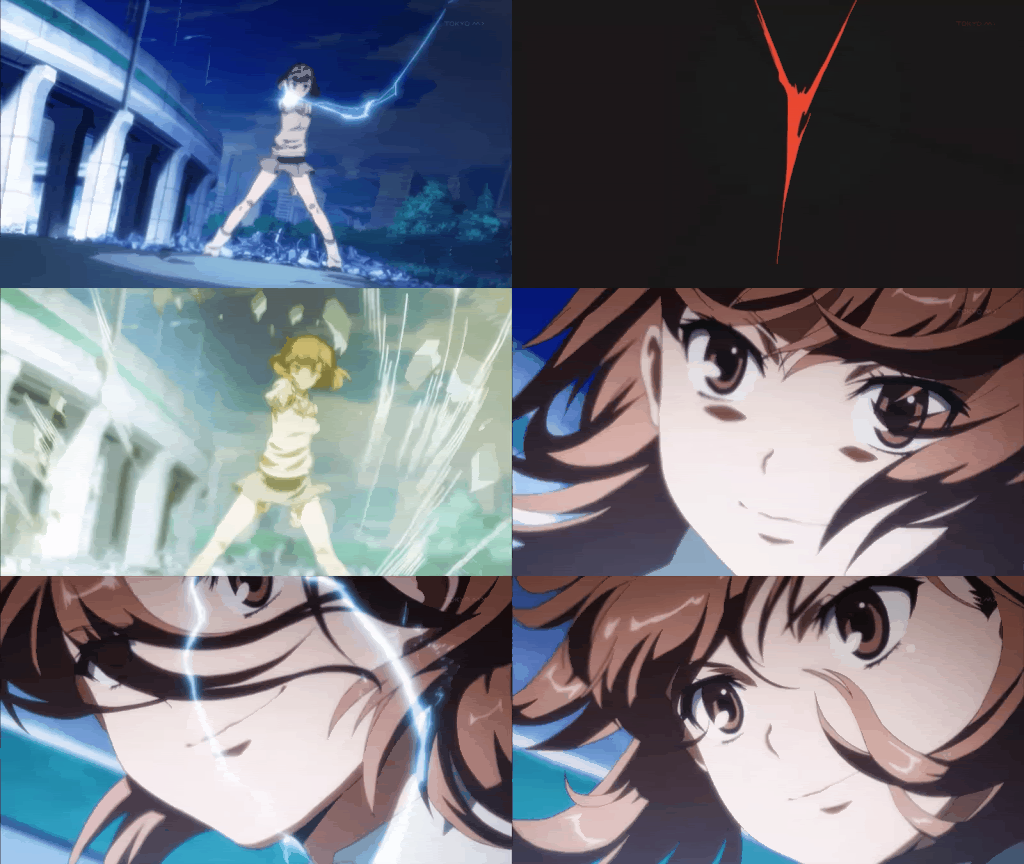
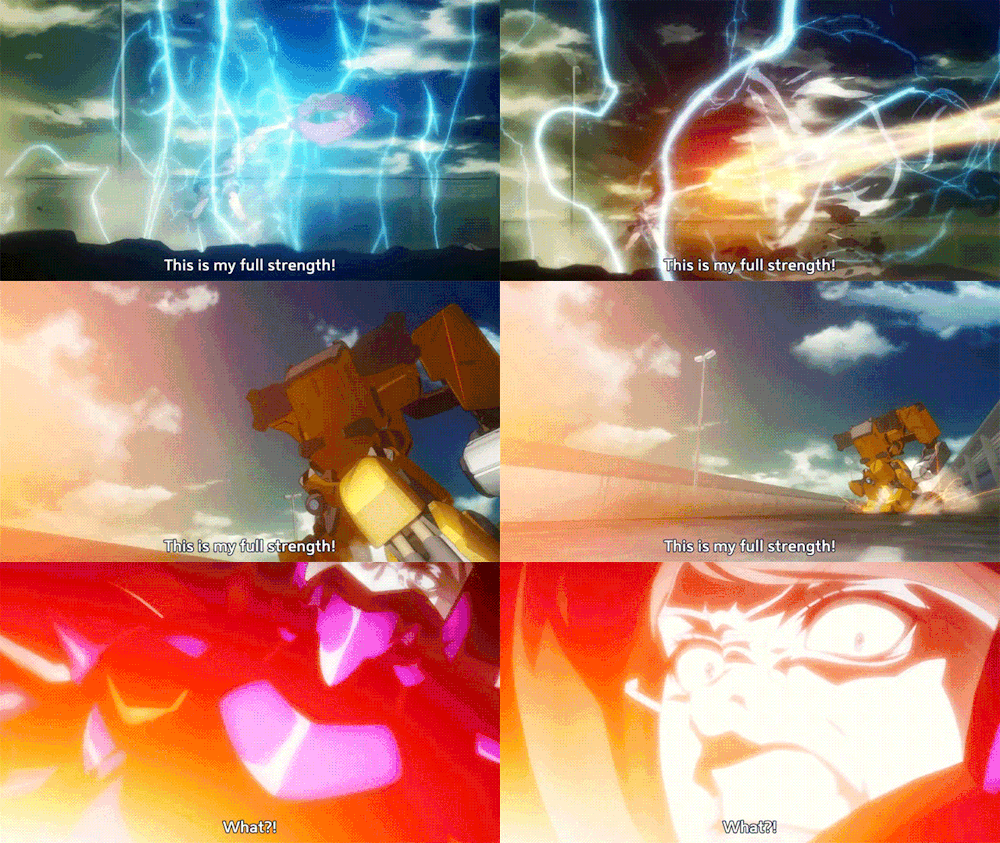
1) MIKOTO. I mean

BOOM there goes the car


BLAM yeah what were you saying?


WHOOPS I MIGHT HAVE LEFT A SCRATCH ON YOUR MECHA

I mean people this badass should need a registered certificate permitting their existence because they could damage some poor fan's heart.

2) THE WORLD. [shameless copy-paste from Facebook] The thing I find really appealing about the Raildex world is how 1) everyone 2) has a near-unique power 3) and an officially-determined skill level.

Normally in scifi/fantasy what you see is a narrow set of stock powers from which characters can choose (e.g. Avatar). Barring superhero fiction, of course, and you could say this is pretty similar to superhero fiction. But then superheroes tend to be the exception rather than the norm in their societies. What is REALLY refreshing about Index/Railgun is that powers are the common thing. They're TAUGHT. And level system is reminiscent of ranks and levels in games--but limiting it to 5 levels leaves enough ambiguity that they don't define a character's exact standing in terms of power, while still maintaining the weight they carry because they're determined via tests rather than speculatively-assigned.

3) I really REALLY like how it manages to discuss many issues of real world education systems despite being about a school for KEWL SUPERPOWERZ. Saten Ruiko's arc had me in tears for majority of it because she was basically lamenting her natural inability and the marginalisation it may have caused in a city that basically values academic standard over everything else.

Add.) Cool nicknames. aGHDG. I mean, Electromaster. Vector Change. Aero Hand. Judgment. Accelerator. Railgun. Mental Out. Heck, even "Dummy Check" is cool for something that makes people forget they saw you. Everything seems to have a nickname and for some reason that REALLY GETS ME ;A;

/this has been a gush post, second in a few days...

14.7.12

THE NIGHT CIRCUS~~~~

Let me just go sit in catatonia for a while. Or squee a bit. Okay, I already did, but I really do think this deserves a reread. On paper. It just doesn't deserve the inferior treatment I gave it, of reading via ebook.

The Night Circus, debut novel of Erin Morgenstern, is another story from a long line of similar ones, about rival performers who fall in love. They are bound to their enmity by a force outside their sphere of control, something started by their fathers, and must continue to hate each other. To do battle till a victor is ascertained. Those tales have always been sad, in the sense that their love is either doomed to fail, or must destroy the confines that contain it, often warranting the sacrifice of something else in return.

And in this story, the setting is a place least likely to harbour a story so bitter--a children's entertainment ground, a locale with connotations of wonder and joy--a circus.

This begins to clue the reader in just how far all deceptions go here. Images for the sake of them. Words for favour, words for control. People going disbelieved, disbelieving; the star of the show disguises truths as lies. Parades lies for glory. And people will see what they wish to see, truths masquerading as lies, lies they wish were truths.

I really do have something for Victorian-esque fiction. Especially fiction like this, centred around a circus that breathes with its inhabitants, dances, metamorphoses, sees insidious infirmity. Stories about shows and displays--beauty for its sake, beauty to bring the spark to the eyes of another, beauty that costs some fragment of the heart. A black and white circus--white flames, black corridors, costumes that do not break anywhere into colour--the chessboard for this battle between bound enchanters, whose endgame terms remain a secret. The bonfire is like its heart, and this heart is linked to the man, but the woman is the performing illusionist, and the flamboyant contest keeps the circus growing, keeps the two competitors attempting increasingly extravagant installations--all in the name of proving the victor.

Then red is brought by the rêveurs, on scarves and in roses, the fanatics who would shed their blood to watch this show. And then in murder, when blood stains the black-white ground so the pristine image is disrupted for moments. And red is brought by the twins born about midnight, in the curls of their hair, when the bonfire-heart is first lit.

Colour themes and images are a centrepiece in this story; they're a substantial part of the plot and sometimes crucial to one's appreciation of events. Some events are detailed for nothing but the poignance of the image that forms, and takes hold, solidifying into a second-long tableau and lingering like a photograph on film.

It is a love story, and those whom I've told know that I adore how the romance was developed, more than ever I have for any other fictional piece. The love story is carried, necessarily, by remote gestures and their symbolism--the couple separated by a thousand miles and a mercurial schedule--and not by look or appearance, not by speech even. Developed upon a series of tricks and illusions that are a grand, expensive form of flirtation--the new tents at the circus becoming introductions, challenges, love letters--magical spectacles seen and exchanged from afar, through which the characters decipher each other's natures and stories.

This is done so well that I can believe in love after two conversations. Because it's not the conversations that matter, and I suppose that's a lesson of the story itself--that the word is worth little in truth. We see what we wish to see, don't we?

I think this book is magical. Meaning that in both the most literal and most figurative of senses. Four hundred pages of it, devoured in a single night, morning and afternoon (unfortunately in digital format, which I regret and must remedy shortly). It was that captivating, mesmerising, enchanting. A lingering spell that seeped through the pages?

The images and the force of creativity behind them are transcendent--not almost, but completely and consummately. We don't imagine white-flame candles adorning trees, or bottles that smell of pirate stories, or  labyrinths of vastly differing environs strung together.

And then again there seems an endless iteration of fourth walls, numerous stories within the story told by a character in this story.

Oftentimes, the book itself serves as an example of what is expounded upon--Mr. Lefevre understands audience response, titillation. According to the Burgess sisters, smell and sound manipulate ambience. Widget knows a story is seasoned by the teller's own flavour and biases.

And that's how it is with this book, one that stirs extreme sentiments of both sorts, that employs the strangest and most beautiful of sensory cues in forming the atmosphere, whose words are so distinctively touched by the author's linguistic patterns.

It's going to be so very long till I can find a book that fills the hole this one left in me when it ended. A warning I'll have to give is that the ending is bittersweet and somewhat piercing, for all the love and hope Morgenstern engendered from the start. Though the words of the storyteller, as always, soothe the wound into something almost sweet. I hope I will find some way to vent my sudden and fierce passion for this piece of literature, this gem that will be for a long while my favourite standalone book in the world.

And I'll definitely have to reread it. On paper. When I'm not reading, I'll get to ogle the beautiful cover design.


7.4.12

to forget a dream

I was watching The Place Promised In Our Early Days, directed by Makoto Shinkai, who has recently become one of my favourite creators in the world. I've come to expect of every film he makes an ending that promises nothing--but this one is takes hopes to heights beyond any of the others, then lets them fall a thousand miles to shatter like glass.

Makoto Shinkai seems to enjoy exploring the subject of the battle between realism and idealism in the aspirations of one throughout the timeline of his/her life. I can't conclude on this for sure, since I've only watched two others, but all have been centred around this same notion of the dreams born of innocence, and their slow vanishing as time scours at the soul and removes all things without any basis in reality. Naturally, this makes for plots that are either very inspiring, or very depressing. This film, in which every event is a clash between the two at their most extreme, manages to be both.

Were you hoping for a full review? Sorry. I can't phrase it. All that can be done is for you to watch it yourself.

29.2.12

the end

Taken off a note I wrote on Facebook.

---

I'm getting chills just thinking about chapter 12. About writing an ending. About the things I've waited almost four years to record in text, about to be actualised at last.

It's been a long time, a long journey. Nothing amazing on absolute standards, but quite a vast achievement for myself. For one, I've never written anything over the course 3.5 years before. I have a little over a million words of lifetime output; this story makes up a fifth of that.

Why an ending? Endings are magical. Reading an ending is ecstasy--sometimes wholesome, sometimes cathartic, sometimes downright painful. In those few pages, in that culmination at the last paragraph, the entire story must be contained, reiterated more powerfully, closed off satisfyingly--yet never closed. An entire world must be left behind, left to stand on its own--a castle to be collapsed or to last in the grinding of time's wind. The ending isn't the flag at the top; the ending is the gate. The place we will always remember as the departure in itself.

Writing the piece is bliss. But writing an ending is an elevated experience altogether. What can I compare it to? Completing the very last examination of your life. Finishing a marathon. The end of childbirth.

The best endings, I feel, do not end. The story is of movement, of change; the ending suggests that this movement and change is everlasting: things do not stall, the world is dynamic, and change will come again--into light, into dark: there will always be heroes to rise to the challenge. How does a story close without closing? A circle.

This is the magic of endings. Someway or other, when the ending comes, we think of the beginning. We lay the origin and the destination side by side, think of the journey we took to get from there to here. And between those points, the voyage passes, like a howling wind, through castles and seas and in the sails of traversing ships, in still summer forests and cave systems that see no light, and down lost rivers--a minute, a millennium. But still, we're here, again, the same yet different, the world completely transformed, the world identical, the world as peaceful as it was at the start. Everything that happens seems to be for the sake of transition, movement, progression out of the darkness--but ultimately, isn't it all in the name of return to the mean? Aren't we only fighting for peace because we know that peace once existed and peace can return?

It's a strange paradox when you take it into the context of writing. The concept of the story, in itself, is hinged upon the idea of progression and change. But it is a progression and change, back to the stable ideal we once had. The darkness must be vanquished so the light can shine again, just as it did in our golden age. The hope for that return is what drives the story. The characters. The idea and inspiration.

And the ending, the ending must carry this all. The ending is the return, the return to that which looked so impossible, a thing of the distant past--like the portrait of heaven in the eyes of a deluded man. The greater the scale of the work, the grander the conclusion. And a happy ending, however Pyrhhic, must be earned in its full worth. Hearts must be torn. The good must be slain. The shadow must win--if only for an instant, that little instant of tilt. And at the end of it all, a reader will look back at the start, and realise how much has changed--the people, the world. That is what makes a good story. That is what strikes the story deep into the heart.

It is daunting to write an ending, it seems, what with these thousands of details that must be tied neatly and kept in balance for the entire course of the climax, the falling action, the resolution. But there is also a strange thing about writing: only half of it is conscious--the scribbling, or tapping of fingers on the keyboard, the intermittent reaching for your drink or turning to the window when your eyes begin to sting.

Of course, conscious and methodical writing is workable. But when it comes to points in the story like the end, when the reader stops analysing (because what is there to analyse, when the plot has unfolded full, and nothing more can be calculated?) and begins to simply, gently, ragingly, /feel/.

That is when you enter this special, ascended state of mind where you aren't completely processing logically anymore. In it, you don't really note individual words as you lay them down; sometimes you don't even know what you are writing--only that you are /writing/, and writing because these words feel right, because these are the first things that your mind sings from its emotional centre. It is the state of mind where, suddenly, links form between ravens and blood and rejection, and when you think of sorrow, you see crystals of snow on windowpanes.

Now that's established, it's not hard to explain why the thought of writing Chapter 12 thrills me so.

Four years is a long time to spend with a story--writing as you please, and yet all the while dropping points, slipping in scenes, all in the drive towards the ending, where it all cumulates and erupts like a supernova and ruins the world or rebuilds it.

Four years of waiting for this ending to happen. Four years of imagining, reimagining, rehashing, reordering that same scene. Which one would have been the best? I wouldn't know, because only one will be breathed life into. Four years is enough to make the thought of letting go of a story heartwrenching.

A little like raising a child, I'd think. You dedicate years of your life to it, watch it find its own footing in the world, let it fly away.

On to the next, though you never can forget it, for all the tears and time you spent.

Funny looking back, seeing how the course of the years is lain down, tangibly, in the progression of words. The writing in the first chapter was fledgling, childish, almost silly. In the tenth, to be frank, I made myself tear up. Half for the story, half for the happiness of seeing what I could do.

Each chapter was frightening, because each ending seemed, in turn, to be the paramount of the story--only to be succeeded by the next. But now comes the ultimate chapter. And I know this climax has to be--like none of the others. It will, must, dwarf the others. It must tie the story up. Make the entire story worth the reader's time.

That daunts me. I am afraid. I am mortified.

To all who have read from start to end, I thank you sincerely. I write for no payment: your satisfaction /is/ my payment. Your dedication makes me feel worthy of my life and my craft, be the story as good as you say, or just painfully amateur. It's far from perfect; it can still be revised hundreds of times and retain its crude imperfection. But such is the journey embarked on when one writes a novel; you learn to accept that you will never, ever, complete it.

14.11.11

5 cm/s


Nothing is more heart-wrenching, than the distance between two people who once loved each other, but will never see each other again.

Strange, how something so real can also be so tragic. Thousands of people will learn of this pain every month, every year. Maybe someday I'll be one of them.


5 Centimeters Per Second isn't a fantasy. It is a story of reality where fantasy still dares to exists, and struggles to survive.

To submit to reality is tragic, isn't it? Here we are in the fantastical years of adolescence, so fiery and ready to stand in the face of the world. Reality will not take us by force. We will fight, for our fight defines us. We are golden; while there is a way, while we are still young and crazy and our blood is still of fire, we will not be stopped. The world doesn't matter for the individual's sake. The individual is all. The world is about what we can make of it.

But there is a cold sad thing that we will perhaps come to know someday. Reality does not take us, does not wrench us away, kicking and screaming.

Reality creeps in, trickles like rain, drop by drop. We slowly let it take us--like death by the cold. We no longer fight, and we no longer hurt to know we will never have what we want. To lose the desire to hold on: that is tragedy.

The movie is about that slow movement into acceptance--that slow movement, away from all the possibilities, all that could be, in those early days, as they vanish one by one like candles by the wind--that slow movement into a steady path that will take us on only one way.


5 centimeters per second: that is the speed of the cherry blossoms as they fall to the ground. So we fall--fall in love, that distance we can only cross once. The cherry blossoms bloom early in spring when the snow isn't all gone; everyone comes to watch--in Japan, an entire celebration is dedicated to this yearly happening. When the petals fall, they turn the pavements and roads a shade of pink that speaks of innocence and fresh--brief--love. It's strangely glorious, for a single living species to incite such wonder.

The cherry blossoms die before the spring is over. They fade into the roads, as if they never existed, and leave them bare. So is love, when it does not actualise itself. Almost nothing eventually, only the bittersweet regret of happiness that was once in full bloom, and is now but a wasted shadow.


There is an irony in the way the story is presented. The backdrops, the scripting, the characters' dispositions--are so much like the way an idealist would tell it, with those fearless declarations, those bold pictures of sunlit roads and classrooms in summertime, the indulgent contrast of light and shadow and colour and emptiness--redder than red, bluer than blue. The way the main characters tell each other of their hopes and their fears, the way they voice out the truth of their fates apart, yet with all the unshattering faith in the world: it's plain heartbreaking.

As the story moves through its three episodes, it grows more and more vibrant, violent, in its telling. Cherry Blossom is gentle enough. The story of Takaki and Akari's childhood is told in a time when the two have already parted ways. As Akari speaks of the scenery in her new residence far away from him, the story of how they met, grew close and separated connects the images: the quote that forms the title of the movie, the friendship that blossomed, their quiet love through the years of their youth. But the viewers know it's inevitably going to end, the taste of imminence is strong.

The dream of watching the cherry blossoms fall together, for one last time, is like the sound of departure almost. This is where the distance is first painted for how unfathomable it really is: Takaki is about to fly to a different city, a place where he can never see Akari again, for good. And for her he weathers the greyness, the cold, of what we see now as the unrelenting hold of reality and future, that which does not want their love to be fulfilled. Reality.
And he wins this battle, but ultimately he cannot win the war. He finds her, deep in the night, their faith in each other strong enough to keep them waiting. In the warmth of a simple fire, they share a last night--and while it lasts, while they are there, it might as well be an eternity. We watch, knowing this is where it ends. We know, there is no possibility of happiness this way again. They know it too. But still it happens, and they smile as they live this night together--live for the moment, the future be what it may, in the whirling cold snows of the dark. (The cherry tree is bare, because of the snow. The spring didn't come in time. But they make do, make do--the snow is beautiful in its own way, and Akari whispers that the snowflakes are a little like petals. They share their last kiss there. And it is, heartwrenchingly, also their first.)

The trains moves out of the station. The morning is beautiful, the most beautiful one yet. The spring seems ready to arrive. But here in the station, this is their very last sight of each other, for the rest of time.

They never gave each other their letters, farewell letters that must have spoken worlds. All those thoughts, still waiting to be said--never said, must vanish now. For the rest of time.


Here comes the episode Cosmonaut. It has been a comparable while since--not long, not a short period either.

Because another lesson of life comes, and really only sets the scene for the last: Love is never reserved for one alone. Many will love one, but only one's love will ultimately be returned. Sometimes, you lose yourself, misplace your feelings--and suddenly you find yourself placing your heart in the hands of someone you never knew would never see you.

Kanae is the subject of this; she is the one who hopelessly falls for one who she can never amount to anything for. Another reality. She swore that on the day she learnt to ride the waves, she would confess. Because to learn to ride the waves was something she had never been able to do, for so many years--the insurmountable challenge of her life. She swore, if she defeated this inability, she could be anyone, do anything.

But sometimes, however passionately you feel, however you swear the happiness of these days is enough to grant you the right to that love, however certain this crazy emotion--akin to drunkenness--makes you feel, it is, in the end, mere delusion. Then you realise, you were always overlooked; Kanae, always like the sea, the blue sea, vast and wild and grand, so passionate and powerful and brilliant--she was nothing, really, beside the sky, and the cosmos beyond, towards which he was gazing, all the while.


Sometimes, you are looking so far that you fail to see the things that were so close by, things within your reach. You aim forward, into a distance that you're unsure you will ever reach--but endeavour nevertheless, because without hope and without that dash of recklessness, there is never the possibility. Takaki continues to dream of Akari; he is the spaceship whose destination is indeterminate. Somewhere out there, somewhere in that unreachable, impassible distance, lies a dream of a life he still believes he can live.

But in that belief there is crippling fear. He writes her messages on his phone--but never sends them. The unspoken words haunt him, and he continues to feel shadows of that desire, to tell her the things he never did.

Perhaps he is as much a victim of that passionate blindness as Kanae is; he believes and dreams, long and tireless--the money is spent, the work is done, the spaceship is launched into the darkness beyond the sky. From here on earth, we see only points of lights--distant stars, nearer planets, the moon and its brilliant face looming so close to us. Where is it headed? Somewhere amongst those beautiful lights lies its destination, a place that it might never reach, but travels towards nonetheless. Because no hope is worth living if the dreamer does not first endeavour--desperately, recklessly, hopelessly--for it.


Episode three, 5 Centimeters Per Second.

Often, you are told to let go and move on, because moving on is the only way you can survive thereafter. But sometimes, letting go is only impossible. Because someday, sometime, long ago, you left a piece of your heart behind, with someone--and she left a piece of her heart with you. And you will never meet again. Never lay eyes on each other again.

They come so tantalisingly close. Is it a dream--as the train passes, and erases that possibility, absolutely, from memory? He turns, but only in time to watch a train--that very thing that first took him away from her, those years ago, in the train station--eradicate that last chance.

The train, which means departure, goodbye, the windows flashing with the sun, taking its passengers to some far-off place. Just like the passengers as they travel away from the ones they love, his dream--everything he still carries as a burden from his past--is taken away, to an unreachable place.

Everyone knows the lesson. Things change. People change. Allegiances shift. Time moves on. Life must as well.

Takaki finds himself a job, the ultimate aim of his education as a child--the education that he had, with Akari, with Kanae, and on his own. He finds himself a girlfriend at the workplace, a marriage of convenience, and contents himself to believe that he has forgotten his past.

But it continues to return--sometimes, when he sees beyond the ceiling and remembers a desire he once had, an aching deep in him, that led him to ride halfway across the country. just to spend a night with a person he once, distantly, loved so.

That love, he realises then, is something absolutely irreplaceable, something--as he looks at his new lover, perhaps a desperate replacement, and feels his heart not moving--she cannot be, however much she tries. Some things are just that way; there is no reason to them, and nothing a person can do to change them. But Akari, too, has moved on, beyond his reach. She has another man, a new home, a new happiness. The rocket never finds its destination; it travels still.

He remembers everything now, though the memories have been distilled to simple scenes, images. He remembers, in the comforting warm of spring--a day in frigid winter when he dreamt of seeing the cherry blossoms fall. He remembers, a cold night, a long journey--a few hours sleeping in the warmth of a small dinner and a love he didn't want to lose. He remembers a barren tree, so dead in appearance.

So many things one must pass by in life; so many things one must shed, in order to welcome the new and move forward into what the world has planned--be it grey or cold or dreary--so many things must be destroyed, without hope for revival. Like it or not, we will lose and forget our childhood someday. Individual events become a blur in the vivid picture of the past; where things once mattered, they are only sweet, fading impressions. The joy and that optimism of youth is a faint remembrance now.

He remembers, still. It is spring now, and at last, the cherry blossoms are falling--the same as every year, the same as every year before that. Those same wondrous flowers, dressing the roads in the a glorious pink, the colour of life and love--that will soon melt away, to be lost and forgotten, long before the week has come to an end. He remembers their first kiss; he remembers the train that took him away.

And somewhere far off, lost as she is in her own different future--she is trying to remember the fading fragments of that very same day, somewhere deep in her buried childhood.